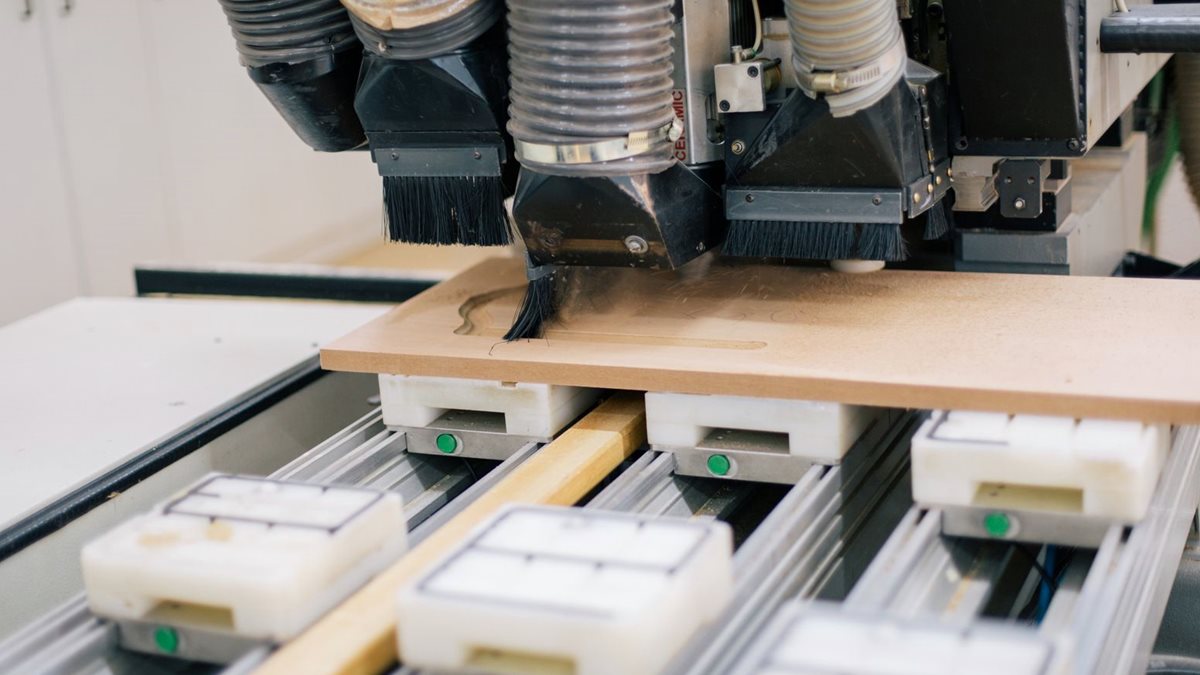
Engineered Board, Melamine & Hardware: What Furniture Is Really Made Of
 Structural Engineering·June 18, 2026·11 min read
When people ask what my job is, the shortest honest answer is that I argue about materials for a living. I'm the structural engineer at FACBOTALL, which means that before a bookcase or a pantry ever reaches production, I'm the person deciding what board goes into it, how thick each shelf needs to be, which glides and hinges can be trusted for ten years, and, often, telling a designer that the beautiful thing they've drawn will sag under a real load unless we change the material here and reinforce it there.
Material choices are where furniture is quietly won or lost. Two bookcases can look identical in a photograph and be built from completely different stuff, and the difference won't show up until one of them starts to bow, chip, wobble or drift a year or two after the sale. Here is, in plain language, what storage furniture is actually made of: the board, the surface finish, the hardware and the ratings. My goal is that by the end you can read a product page, ours or anyone's — and know which words mean something and which are just decoration.
Engineered board: not all "wood" is the same word
Almost no affordable furniture is solid timber, and that isn't the scandal people sometimes assume. Engineered board, board made from processed wood fibre, is dimensionally stable, uses timber efficiently, and when it's the right type and properly finished it's an excellent material for shelves, panels and cabinet carcasses. The problem is that "wood" on a listing can mean several very different materials, and the gap between the best and worst of them is enormous.
The most common is particle board: wood chips pressed with resin. Its reputation is worse than it deserves. A dense, well-pressed particle board with a good melamine surface is perfectly sound for most shelving and cabinets. Hence so much of the furniture market, including plenty of expensive brands, is built from it. What separates good particle board from bad is density and thickness. A low-density, thin board sags and strips screws; a dense, adequately thick one holds weight and fixings well. Then there's MDF (medium-density fibreboard): finer fibres pressed to a smoother, denser board that machines cleanly and takes a finish beautifully. It is why it's favoured for doors and shaped fronts. At the top sits plywood: thin veneers glued in alternating grain directions, strong and excellent at holding a screw, and more expensive, so it appears where its strength earns its cost.
The single most useful thing to understand is that thickness and density matter more than the category name. A 15mm dense particle board shelf outperforms a thin plywood one. When we spec a shelf, we're really specifying how much it will deflect under its rated load, and that comes down to the board's thickness, its density, and how the shelf is supported: not to a marketing word.
| Board type | Made from | Strength / screw hold | Best used for |
|---|---|---|---|
| Particle board | Chips + resin, pressed | Good if dense & thick | Shelves, carcasses, cabinets |
| MDF | Fine fibres, dense press | Medium; machines cleanly | Doors, shaped fronts, panels |
| Plywood | Cross-laminated veneers | High; holds screws well | Load-bearing structure |
| Solid timber | Sawn wood | High but moves with humidity | Show frames, premium pieces |
The melamine finish: the surface that decides daily life
Here's a word worth understanding, because it's on most of our product pages and most people gloss over it: melamine. A melamine finish is a decorative paper impregnated with melamine resin and fused to the board under heat and pressure, forming a hard, sealed surface bonded to the panel. It's genuinely one of the best value surfaces in furniture, and it's why our pieces are described as water- and scratch-resistant and easy to wipe clean.
The advantage over a sprayed or painted finish is durability where it counts. A melamine surface shrugs off the rings, scuffs and knocks that daily life throws at a bookcase or a pantry, doesn't need re-finishing, and wipes down with a damp cloth. It's also consistent. The warm white, black, walnut, cherry and golden-phoebe tones across our range are the same panel to panel and piece to piece, so a bookcase and a matching cabinet actually match. The thing that separates a good melamine finish from a poor one is the fusing: done properly it's a continuous, even shell; done cheaply it can be thin or unevenly bonded and will eventually lift at an edge. Which brings us straight to the part that protects it.
People think the finish is about colour. It's about the ten thousand times someone sets a mug down, drags a book across a shelf, or wipes a spill. Colour is the easy part; the durability of that surface is the point.Karen Ellis, Structural Engineering
Edge-banding: the cheap step that saves the whole panel
A melamine panel is only sealed on its faces. The cut edges are raw board unless they're banded, and that's where furniture quietly fails. Edge-banding glues a thin sealing strip around each cut edge; without it, a raw edge chips on the first knock and drinks up moisture from a damp room until it swells. With it, the edge is smooth, sealed and stable.
This is the cheapest corner in the whole build to cut, because hidden edges don't show in a photo. A budget maker bands only the front edges and leaves the back and interior edges raw, and those are exactly where the damage starts, months after purchase. The tell you can check with your own hands: run a thumb around any edge of a piece, including the ones you don't normally look at. Sealed and smooth all round is a maker who banded properly; rough bare chipboard on the hidden edges is a maker who didn't. We band because a water- and scratch-resistant melamine surface is only as good as the sealed edge that keeps moisture out of the board beneath it. We go deeper into how banding is actually applied in our walkthrough of how storage furniture is made.
Hardware: the small parts that generate the most complaints
Beyond the board, a piece of storage furniture lives or dies on its moving parts, and if I had to name the single component that causes the most post-purchase disappointment relative to its cost, it would be the humble drawer glide, closely followed by the door hinge.
A drawer that rolls smoothly out of the box but drags, tips or falls out of its track a year later is almost always running on glides that were under-specified to shave a dollar off the build. Glides are rated in cycles — how many open-and-close movements they're built to survive, and a good one is rated for tens of thousands and stays smooth to the end, while a poor one isn't rated at all because nobody tested it. On a dresser that gets opened several times a day, this is the difference between storage you enjoy and storage you fight. The best glides add features that matter in daily use: a soft-close damper so a slammed drawer doesn't bang, a stop so it can't be pulled out onto a foot, and full extension so you can reach the back.
Hinges are the door equivalent. A quality concealed hinge holds its adjustment and can be re-tuned with a screwdriver if a door drifts; a cheap one loses its setting and the door slowly goes crooked. And then there's the piece of hardware people are most tempted to ignore: the anti-tip kit. It's a bracket and a strap that anchor a tall piece to the wall, it costs pennies, and it prevents the one genuinely serious accident in this category: a tall bookcase or dresser tipping. We include it as standard on every tall piece, and I'd urge you to fit it whatever brand you buy.
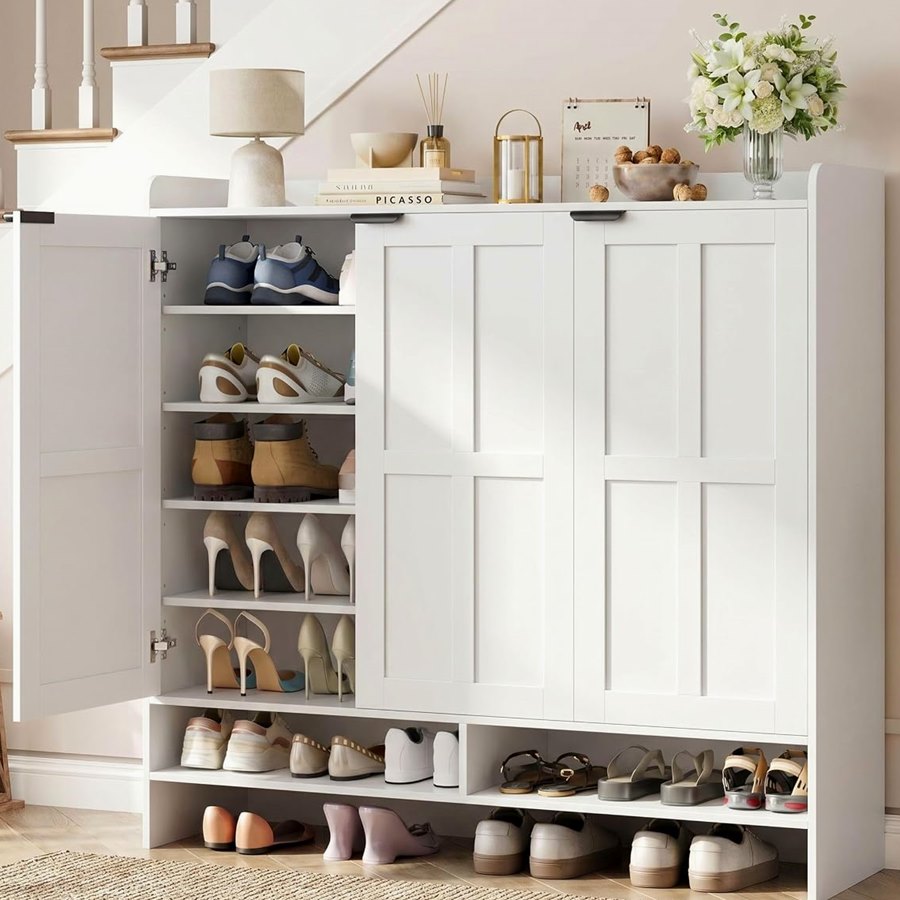
Wide Farmhouse Shoe Cabinet, 47.6", 3 Doors, White
A cabinet is a hardware showcase: three doors on hinges that must stay aligned, and four adjustable shelves whose pin holes were bored to line up. Small parts, specified for years of daily entryway use.
View details & specs →Shelf ratings: the number most abused in furniture
Since I've mentioned load ratings a few times, they deserve a section, because they're the most abused number in this industry. A shelf rating is a promise: this shelf will safely hold this much. The problem is there's no universal, enforced way that number has to be arrived at, so two shelves can both say "holds 40 lbs" while meaning completely different things.
A rating done honestly comes from a load test: you take a finished shelf, supported the way it will be in use, apply weight in a controlled way, often beyond the stated number to build in a margin, and measure how much it deflects and whether it recovers. A rating done dishonestly comes from a spreadsheet, or worse, from copying whatever the competitor down the page wrote. Nothing is physically tested; the number is chosen because it sounds reassuring.
You can't fully tell these apart as a buyer, but there are tells. A suspiciously round, suspiciously high number on a thin shelf is a flag. A rating that's specific and a little modest is more likely to be real, because a maker who actually tested is stating what they measured. And the pieces with the most credible ratings tend to be the ones where the maker also talks openly about board thickness and reinforcement. Our shelves are reinforced and rated from around 33 lb up to 66 lb per shelf depending on the piece: real figures from how the shelf is built and supported. That is the reason we're comfortable telling you a triple-wide bookshelf will carry a full row of hardcovers without bowing.
| Marketing phrase | What it often really means | What to look for instead |
|---|---|---|
| “Sturdy wood construction” | Unspecified board, possibly thin | Named board + a stated thickness |
| “Premium finish” | Could be thin sprayed paint | The word “melamine” and “scratch/water-resistant” |
| “Holds up to 100 lbs!” | Often an untested round number | A specific, credible per-shelf figure |
| “Easy assembly” | No guarantee holes line up | Jig-drilled, numbered hardware, test-built |
| “Solid and stable” | May omit anti-tip entirely | Anti-tip kit listed as included |
How the materials age, and the care that doubles their life
Materials aren't static; they age, and how they age is part of the buying decision. The good news is that the care that keeps furniture young is trivial. A melamine surface ages extremely well, it doesn't need re-finishing and resists everyday wear, and its only real enemy is standing water reaching an unsealed edge. It is why banding matters and why you wipe spills rather than let them sit. Engineered board holds its shape indefinitely if it stays dry and its shelves aren't loaded past their rating; the two things that age it prematurely are moisture and sustained overloading.
The parts that genuinely wear are the moving ones. Glides last far longer with an occasional wipe of the track and a touch of dry lubricant if they start to drag. Hinges stay true with a periodic turn of the adjustment screw. And the single most impactful piece of maintenance on any assembled furniture is re-checking the main structural bolts a couple of times a year, because a new piece settles slightly and a bolt that's crept even a little is the seed of every wobble. None of this is difficult; all of it roughly doubles the useful life of the materials. Our assembly and care page spells out the full routine, and it applies to any well-made piece, not just ours.
How to read a product page like an engineer
Put all of this together and you have a way of reading any furniture listing that cuts through the marketing. You're looking for specifics, because specifics come from testing and vagueness comes from copywriting. Here's the checklist I'd use if I were buying furniture from a company I didn't work for:
- Does it name the board and a thickness? "15mm reinforced shelves" beats "sturdy wood" every time.
- Is the finish named? "Melamine, water- and scratch-resistant" is a real claim; "premium finish" is a shrug.
- Are the edges banded? If a maker mentions sealed edges, they did the step; if the hidden edges look raw in the photos, assume they skipped it.
- Are the glides and hinges described? Soft-close, full-extension, a stated cycle life — someone who tested. Silence: someone who didn't.
- Is the shelf rating specific and credible? A modest, exact number beats a huge round one.
- Is anti-tip hardware included? Standard inclusion signals a maker confident in the whole build.
The reason we're this specific about materials is the same reason we test our furniture before it ships: it's the standard we'd want as customers. If you want to see how these materials become a finished piece, read how storage furniture is made. To turn all of this into a confident purchase, our guide to judging furniture quality before you buy is the next step. Or browse the full FACBOTALL range and read a few product pages with your new engineer's eye.

73.5" Tall Bookcase, Deep Shelves with Doors, White
A good test of everything in this guide: deeper reinforced shelves that hold oversized books without bowing, a melamine surface that wipes clean, banded edges, and doors on hinges that stay aligned. Materials chosen for the job, not the photo.
View details & specs →Karen Ellis
Structural Engineering · FACBOTALLPart of the team behind FACBOTALL's storage furniture. Read more about how we work, or browse the full range.